

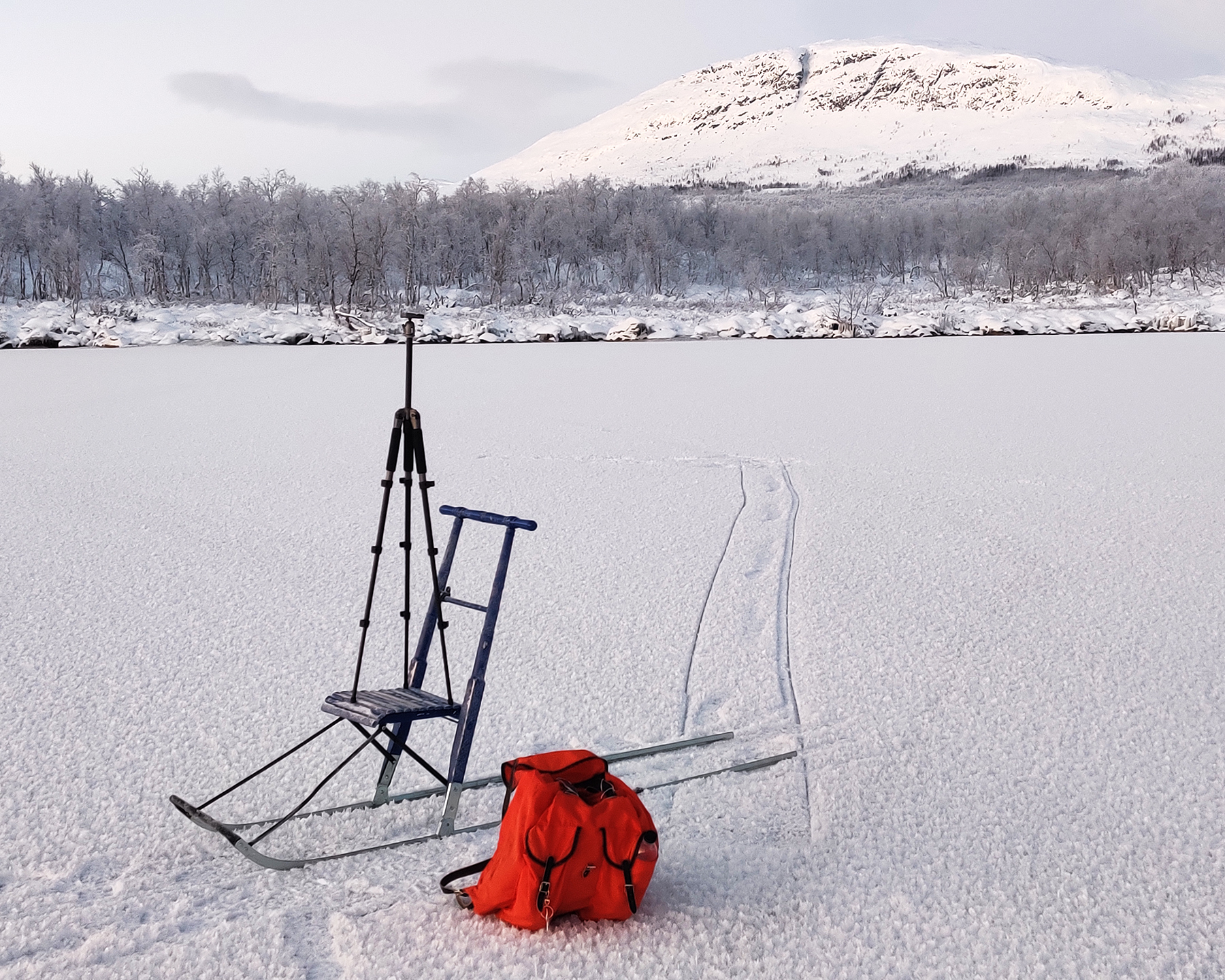
Image: A mobile camera tripod.
Indicators of the ecological condition keep going down: terrestrial animal populations, tropical forest area, health of coral reefs, the size of the remaining carbon budget etc. But if we interpreted the state of the environment from nature imageries, would we land in the same conclusions?
At least to me, nature looks greater and purer in images than in reality. Images of snow-covered trees lack the perspective of time which would reveal that winter came late and soon the snow is gone. A photographer does not turn their camera 180 degrees to show that they are standing next to a car on a road that cuts through a protected area. More often artists find inspiration to nature themed works from urban than rural lifestyles.
A survey by Sitra (2021) found that 74 % of Finnish citizens name seeing spectacular images of nature important or very important ways “of being with nature”. Since images and visual observation are key to sensemaking of the world, it seems likely that pictures of endless wilderness, monumental glaciers and wild animals have an impact on the public understanding of nature.
Are nature imageries distancing us from ecological realities? I began to examine this question at the Ars Bioarctica residency in late November and early December 2025. Not necessarily an artistic project, it connects to my background as a Master of Environmental Science who works as an artist.
Visiting the residency in early winter
Early winter is an exceptional season (as all seasons), since the polar night begins. The tones of sunrise and sunset last for hours each day before the sun goes down for months. Walking around the terrain is still quite possible, as snow depth is limited – now it was about 30 cm. The station does not provide skis, so getting around in higher snow depth could be complicated if you do not have your own. The winter came late but temperatures ranged between -26 C and -10 C during my time. Helsinki had an awful, rainy, and dark weather, so the time of my visit was well optimized! However, years are not brothers when seasons change.
Kilpisjärvi Biological Station has very few guests during winter times if there are no courses or major visits. The house was basically empty for part of the time since the staff was away in a meeting of research stations.
In addition, I would like to point out that getting to the grocery store in the village was much easier than I thought – over the lake ice with a kick sledge offered by the Station. With more snow you would need skis again.
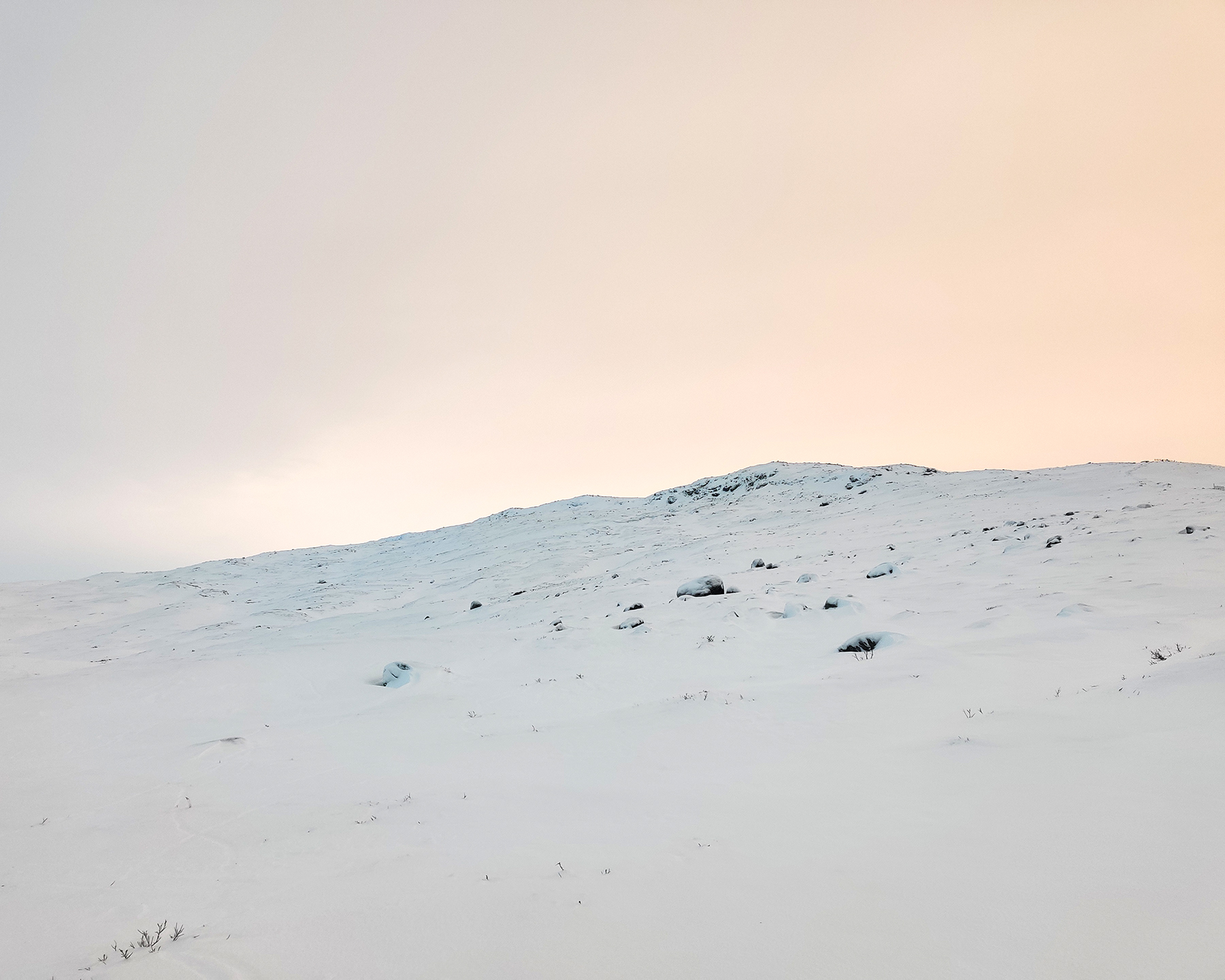 Image: Tones of setting (or passing by?) sun in the middle of day at 13:00.
Landscape photography by day, writing at ‘night’
My work plan was mainly about starting an essay. Is it good to focus on writing in an exceptional location? Well, I ended up spending the few hours of daylight outside, making trips to nearby locations and visited Norway. The darkness of mornings and evenings provided me enough time to write. After the polar night set in there were still quite many bright hours daily.
It is yet unclear what to do with the large amount of landscape photographs I made in excitement with my medium format film camera. As all of my photographic works, they relate to the essay’s topic as representing nature through images. However, I usually avoid giving a polished image and instead choose to show ecological transformation in landscape photographs.
So what is the essay about?
Sustainability science has used the concept of human–nature relationships in studying the social causes of the ecological crisis. Drawing from deep ecology and other theoretical disciplines, philosophers and scientists have argued that the highly technologized society and urban lifestyles have distanced humans from natural systems. Most people have very little to do with the environment: we interact with ecological processes at the end of long production chains and networks of technology. Thus, we do not know how to live with ecological processes – how agriculture works, when is the right time to eat fish, is it going to rain soon? When ecological issues start to emerge, we are not very interested since they have quite little to do with the practice of living a modern life in the way we experience it. Please allow me to simplify the obviously more complex literature.
In my essay, I focus on the distance in human–nature relationships produced with images. The visual and aesthetic dimensions of reality are arguably less studied perspectives in social and sustainability research than their contribution to human experience. Images play a role in how nature is conceptualized: even science communication uses images for infographics and illustration. The idea of the ‘objective’ nature – the playground of biological and environmental sciences – is therefore partially produced with images.
Maybe even more interesting is how cultural and technological change transforms the concept of ‘nature’. Today the immersiveness of games and virtual reality allows to experience completely crafted ‘nature’. Until recently, the so-called ‘human nature’ – language, intellect, expression of emotions – had been untouched by simulations. Now artificial intelligence (language models) questions this aspect of naturalness. Is there a trend of nature being replaced by its models projected with technology?
Last remarks
All in all, I enjoyed my time at Ars Bioarctica and the essay got a firm start. Conversations with Leena Valkeapää were definitely a highlight. With first-hand, academic and artistic experience of reindeer herding and local culture, I am sure there are not many Leenas.
One thing to consider if you are from Finland is that grants for in-country residency travel have been cut off. Also, if you wish getting to know researchers, it could be smart to ask the Station about current research activities before booking the residency slot.
Thanks Bioart Society for running the special kind of a residency and the University of Helsinki for collaborating with an art institution!
Lauri Lähteenmäki is a Helsinki-based Finnish artist (Master of Fine Art) and environmental expert (Master of Science) whose photography-based artmaking draws from environmental science. Lähteenmäki is best known of his series Vihreän kullan kuume (Green Gold Fever), which documents the impacts of industrial forestry in the Finnish landscape. In addition to artmaking, Lähteenmäki focuses on research and writing.
REFERENCES
Sitra, 2021. Suomalaisten luontosuhteet. Kantar TNS. p. 39