


28 Aug 2026 11:00 — 14:00
Location: Cinema Orion
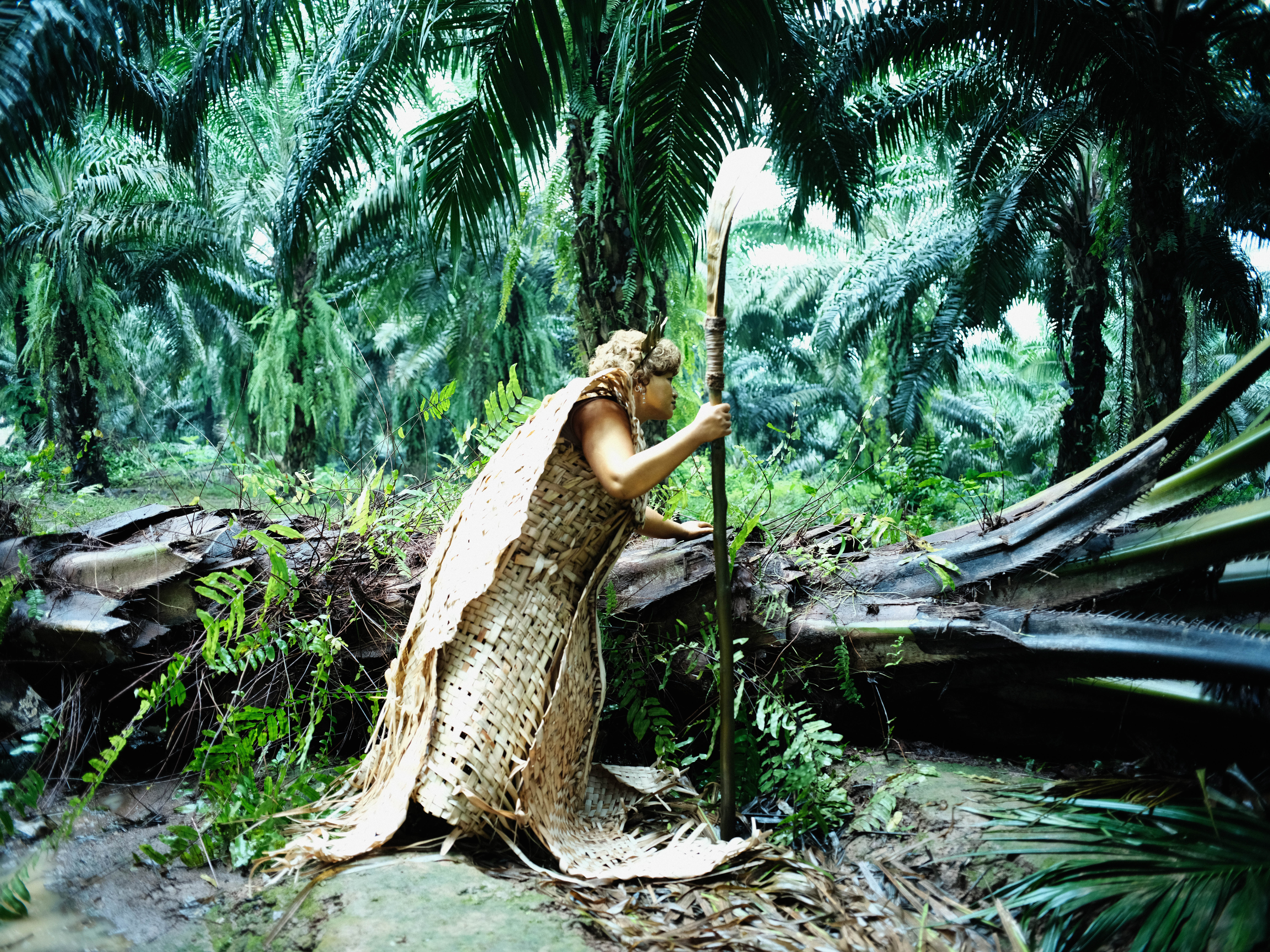
Image: Elia Nurvista, Plantation Tragedy, 2026, behind-the-scenes photograph. Photo: Wimo A. Bayang.
Plants have long offered filmmakers ways of thinking through longing, memory, resistance, and power in different political contexts and through diverse cinematic formats. The film programme consists of eight short and medium-length films that were produced over the last seventy years,blending various chrononologies and traditions from film history, such as lyrical cinema, queer experimental film, militant documentary, experimental fiction and essay film.
Several works in the selection explore how moving image artists have depicted the expression of desire through plants: a gardener tending to beauty as a subtle act of resistance; an artist cutting a mango in different ways to express longing for home; interpretations of the mythical metamorphosis of a female body that becomes a laurel tree instead of submitting to a god's grasp; and female lovers and friends photographed among blooming fruits and vegetables. Other selected films discuss appropriation and violence: a colonial archive of wildflowers reclaimed from the institution that filmed them, a plantation's afterlife replayed as a fever dream, three thousand striking women employees of a tobacco factory, and a landscape brutally laid bare through the surveillance of the everyday.
Curated by Danai Anagnostou, the programme unfolds as follows:
Surveilling a Crime Scene by Alana Hunt (Australia/ Miriwoong Country, 2023)
The Flowers Stand Silently, Witnessing by Theo Panagopoulos (UK, 2024)
Women I Love by Barbara Hammer (USA, 1976)
Daphne was a Torso Ending in Leaves by Catriona Gallagher (Italy/ Greece/ UK, 2024)
Tobacco Embers by Yugantar Collective (India, 1982)
Plantation Tragedy by Elia Nurvista (Indonesia, 2026)
How to Eat a Mango by AK Wane (Senegal/ Finland, 2024)
Sapvonela (Song about a flower) by Otar Iosseliani (USSR, 1959)
Booking: To receive a seat for the screening please RSVP here
Venue: Cinema Orion, Eerikinkatu 15, 00100 Helsinki.
Access: Cinema Orion is located in the city centre, in Kamppi – a 12 minute walk from the main train station. Unfortunately Cinema Orion is not fully accessible at the moment. Two wheelchair seats are situated at the balcony of the Cinema. We kindly ask you to contact the cinema beforehand (lipunmyynti(at)cinemaorion.fi) when planning to arrive at a screening, to ensure you a more pleasant visit.
This event is a collaboration between Bioart Society, Food Art Research Network, Kenno Filmi and Cinema Orion.
Danai Anagnostou's contribution has been supported by AVEK, Mediarata 2026. Barbara Hammer’s film is Courtesy of the Estate of Barbara Hammer, New York and Electronic Arts Intermix (EAI), New York.
Featured artists bios:
AK Wane is an artist, writer and curator from Dakar, Senegal, currently based in Helsinki, Finland. They work primarily in video, in between experimental and documentary practices, to give voice to historically underrepresented people. They work within and without the archive, searching for meaning in what has been told and what has not. They will be in residence at Jan Van Eyck Maastricht in 2026.
Alana Hunt makes art, books, films and social interventions. Her life across Miriwoong, Gija and Gadigal Countries in Australia and her ongoing relationship with South Asia—and with Kashmir in particular—shapes her engagement with the violence that results from the fragility of nations and the aspirations and failures of colonial dreams. Alana’s work is shaped by a long-term, forensic approach to artistic research; she works slowly and deliberately, often over many years.
With a career spanning fifty years, Barbara Hammer is recognized as a pioneer of queer cinema. Working primarily in film and video, Hammer created a groundbreaking body of experimental work that illuminates lesbian histories, women’s health and aging, and global political struggles. Guided by her urgent need to document communities rarely represented in mainstream cinema, she asserted that “radical content deserves radical form.” Using documentary and found footage, her works are characterized by her robust experimentation with montage, superimposition, and overexposure.
Catriona Gallagher is a visual artist and filmmaker working between the UK and Greece. Her work probes at the collision of manmade and natural worlds, navigating overlooked details in our physical surroundings and their mirroring psychological landscapes. She uses moving image, drawing, writing, and research processes to map physical and conceptual traces of human and non-human relations. Her work has been shown in film festivals and exhibitions in the UK, USA, Italy, France, Ireland and Greece, where she co-founded A - DASH project space in Athens in 2016.
Danai Anagnostou is a producer for film and artist moving images and a doctoral candidate at Aalto University. In 2019, she co-founded Kenno Filmi, a production company in Helsinki that hosts projects by international filmmakers, researchers, and artists. Her research is situated at the intersection of production studies and production history, emphasizing the histories of feminist film collectives and women’s collaborative praxis, aiming to identify methods and practices for reconstructing and reactivating unofficial and incomplete archives. She is conducting this study with the support of the Kone Foundation (2022-2026).
Elia Nurvista is an Indonesian artist and independent artistic researcher whose work examines the politics of food through contemporary art, research, and pedagogy. Using food as a social, political, and ecological lens, she explores labor, extraction, everyday consumption, and collective knowledge, while tracing their entanglements with ecology, gender, class, and geopolitics. In 2015, she initiated Bakudapan Food Study Group, a Yogyakarta-based artistic research collective focused on studying food within broader cultural and political contexts.
Otar Iosseliani initially studied mathematics and physics at Moscow State University before transferring to the state film institute (VGIK) to study film directing. His graduation film, April (1961), was denied theatrical distribution by the authorities and to obtain his diploma and continue working, he took a job at the Rustavi metallurgical factory. This firsthand experience directly shaped his documentary Cast Iron (Tuji, 1964). Iosseliani’s subsequent films faced systematic suppression, severe distribution restrictions, or were shelved for years. In France, he established a second chapter of his career, directing a long series of highly acclaimed features and documentaries.
Theo Panagopoulos is a Greek-Lebanese-Palestinian filmmaker and academic based in Scotland. His work explores themes of collective memory, displacement, fragmented identity and language in an equally sensitive and political way.
Yugantar was India’s first feminist film collective. Founded by Deepa Dhanraj, Abha Baiya, Navroze Contractor and Meera Rao in 1980 the collective developed four films together with existing or ensuing women’s groups: with domestic workers in Pune (Molkarin, 1981), female factory workers in Nipani (Tambaku Chaakila Oob Aali / Tobacco Embers, 1982), with Stree Shakhti Sanghatana, a feminist research and activist collective in Hyderabad (Idi Katha Maatramena / is this just a story?, 1983) and with members of the Chipko environmental movement (Sudesha, 1983).