

During my Learning Materials residency in Suomenlinna, I developed my material and mythological research practice centered on transformation: turning one thing into another, finding one form inside another, and allowing materials to move between vegetal, animal, human, and mythical states.
I began from the idea that environments communicate through materials. The surfaces of plants and animals can seem to register or express emotion, while environments can mirror myths, and myths can mirror the environments from which they emerge. For me, myth is a way of creating empathy and mapping the relationships between humans, other species, landscapes, and materials. Rather than depicting and working with existing stories, I developed new myths from what I encountered around me in Suomenlinna. The environment became a source of characters, bodies, creatures, and stories – naturally showing a viewer a mind of a local inhabitant. I tried to see what my mind could pick up from the environment that surrounded me, while also talking to local people and being exposed to Finnish stories written prior.
A central method in my research was mirroring. I looked for forms that could transform through resemblance. Seaweed could become hair or wet animal fur. When hardened, seaweed could resemble the beard of a selkie. Stars, fences, rocks, plants, and other forms found in the environment became starting points for imagined bodies. Through these transformations, I move between vegetal, animal, human, and mythical identities.
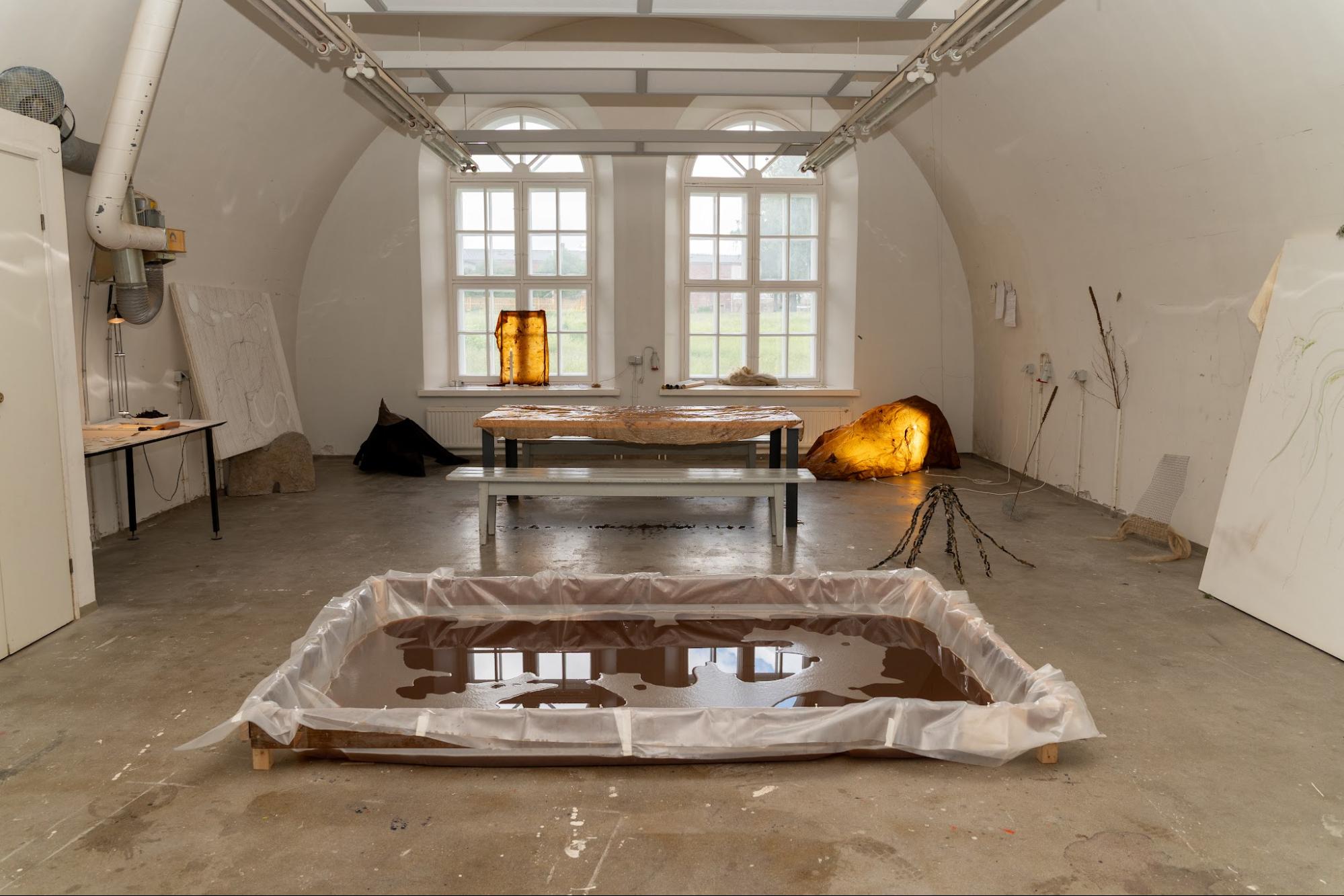
I became interested in shifting states between living and decaying substances, and between what is considered beautiful and ugly. I experimented with kombucha leather, leather, seaweed, organic matter, wood, steel, and foraged materials, using drying, hardening, sewing, fermenting, and preserving as sculptural processes. I started thinking about preservation almost like making jam, except that instead of preserving something to eat, I preserve organic materials as sculptures.
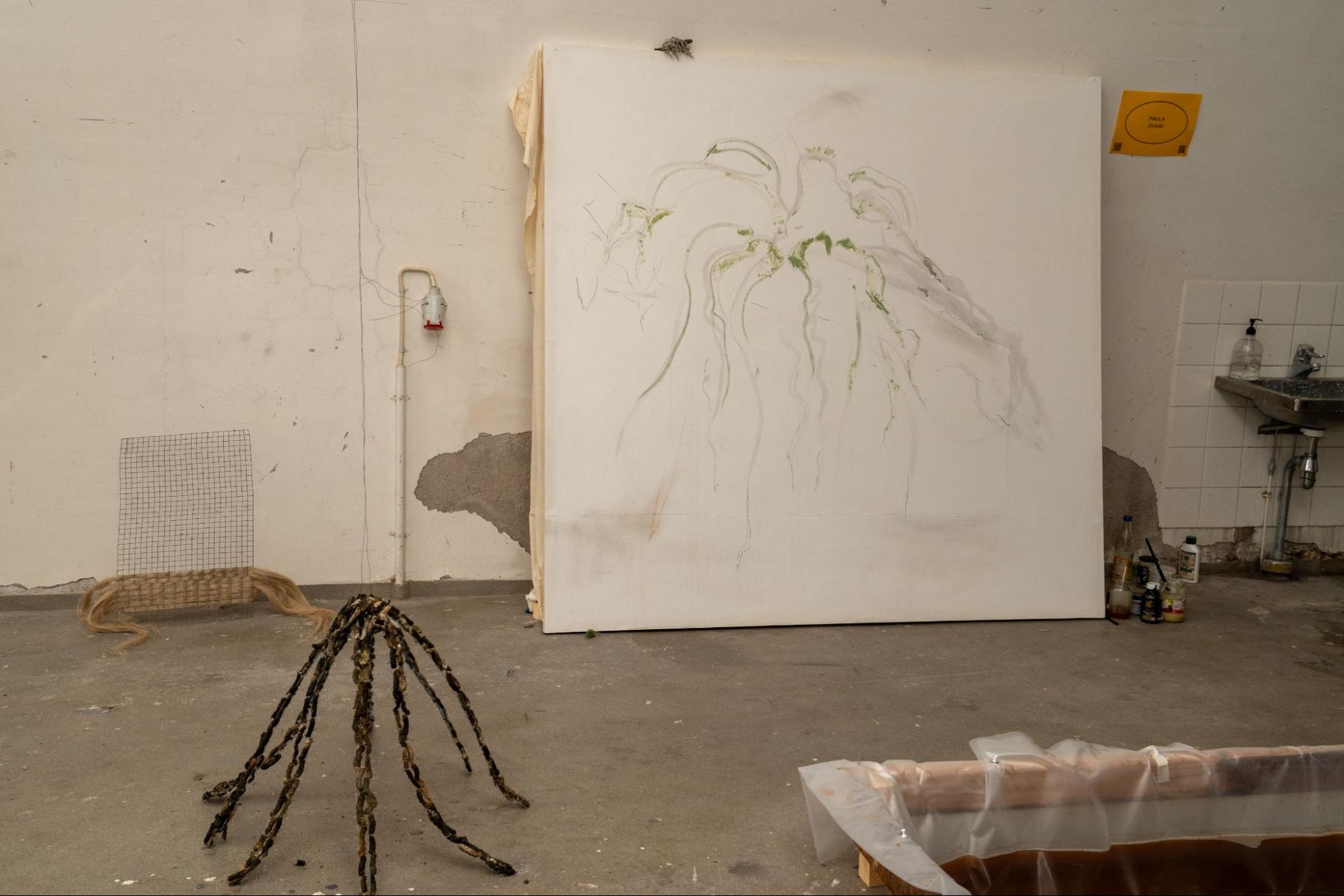
This led to my sculptures made from steel skeletons with changeable leather and kombucha skins. I imagine these structures as flowers with human bodies inside them, flowers that are actually people from the island disguising themselves as plants. The skeletons can remain the same while their skins change, so one structure can become many different bodies. These sculptures suggest camouflage, masking, transformation, and the possibility of becoming something other than what you appear to be.
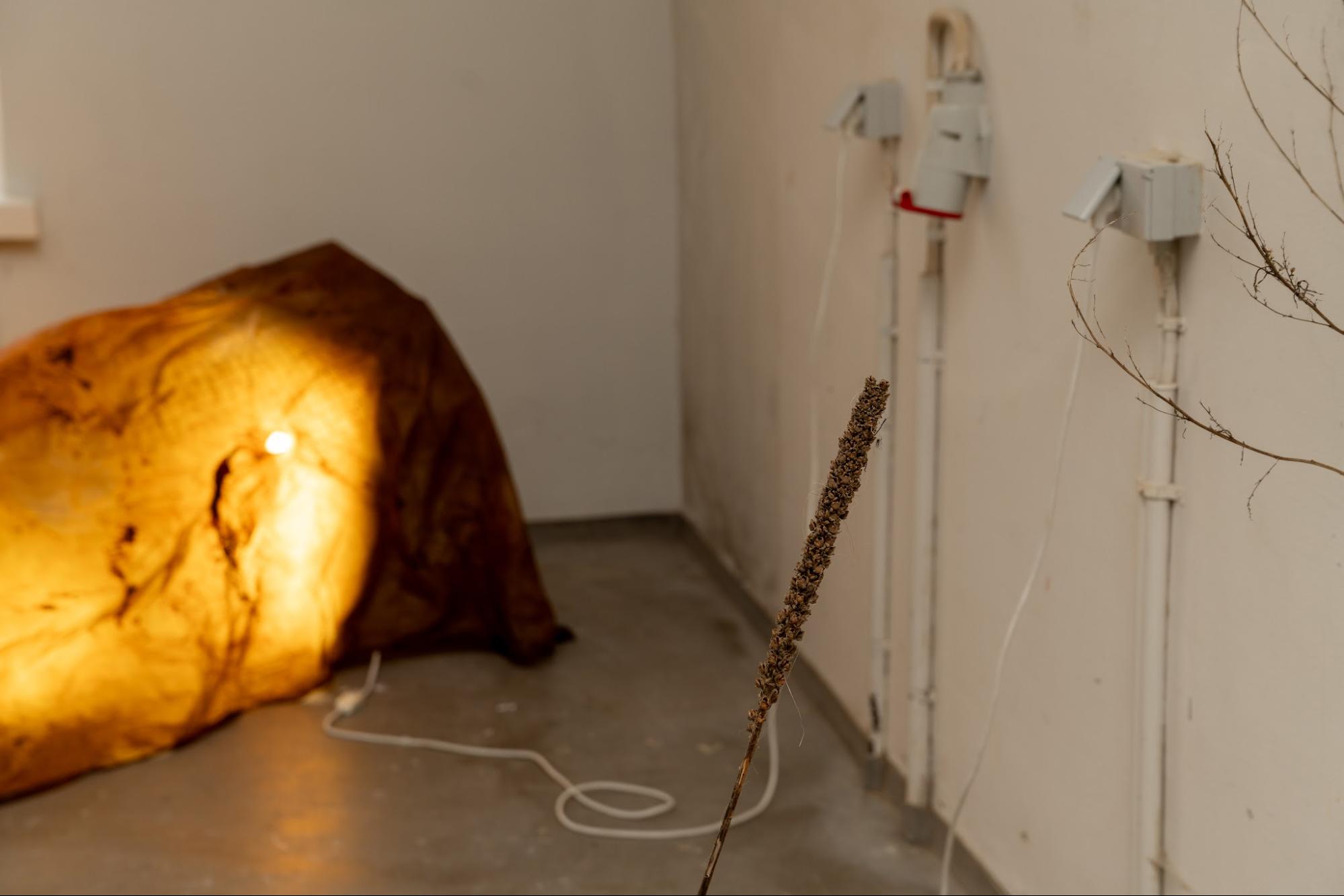
One of the myths I developed is about glowing rocks along the sea. At night, when walking by the water, rocks and cliffs can seem to come out of the sea and shine like amber. In my story, these rocks are mysterious beings that appear at night and sometimes confuse or deceive people and sailors, drawing them towards the shore. The landscape becomes a living presence with its own behaviour and intentions.
Another creature I imagined is the tree sheep: small green sheep that live among the lichens on trees. Their fur resembles the surface of the tree, making them difficult to see. Sometimes they jump down, and if you are lucky, you might catch one. This creature comes from a fallen piece of tree and lichen on it, my interest in camouflage and in the boundary between plant and animal, where one form can disguise itself as another. Lichen looks like sheep, lives on the tree, tree becomes sheep.
I also created a myth about a bird whose leg is a snake. From a distance it looks as though the bird is simply standing, but its leg is actually a snake. This strange body allows the bird to communicate with and befriend animals outside its own flock. Eventually, because of this difference, it leaves the flock of birds. For me, this is a story about how an unusual body can become a possibility for connection. What separates the bird from its own species also allows it to form relationships with others.
Another important myth for me became The Geese Castle. I began imagining a castle or a picnic shelter made from goose droppings, transforming a material that is usually considered disgusting or unwanted into an architectural and ornamental structure. In its imagined future form, it could be cast in steel or bronze and hang above the heads of both birds and humans, creating a shared shelter rather than a place of conflict. The ugly material becomes beautiful architecture and a possible meeting place between species. A best picnic place and public sculpture at the same time.
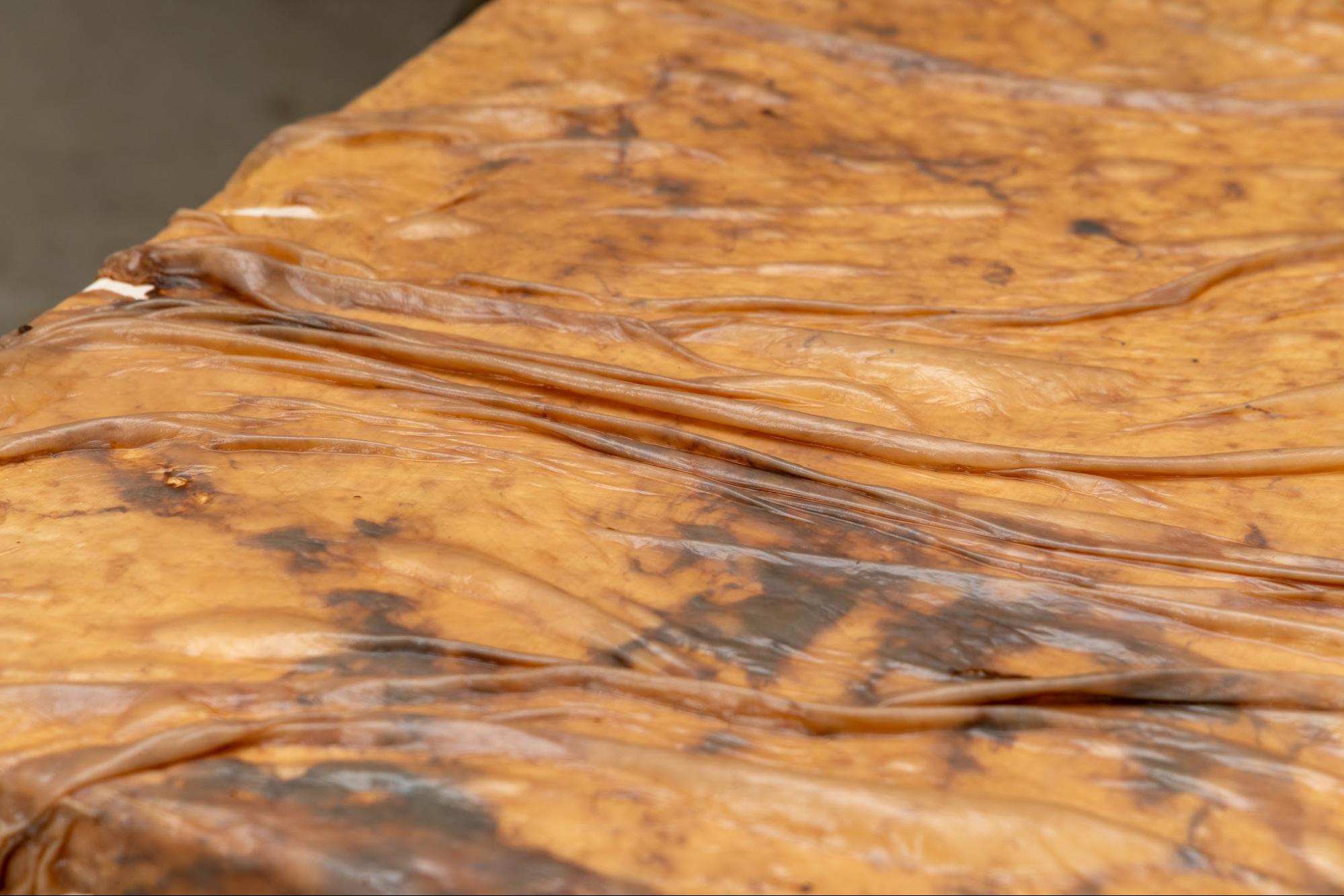
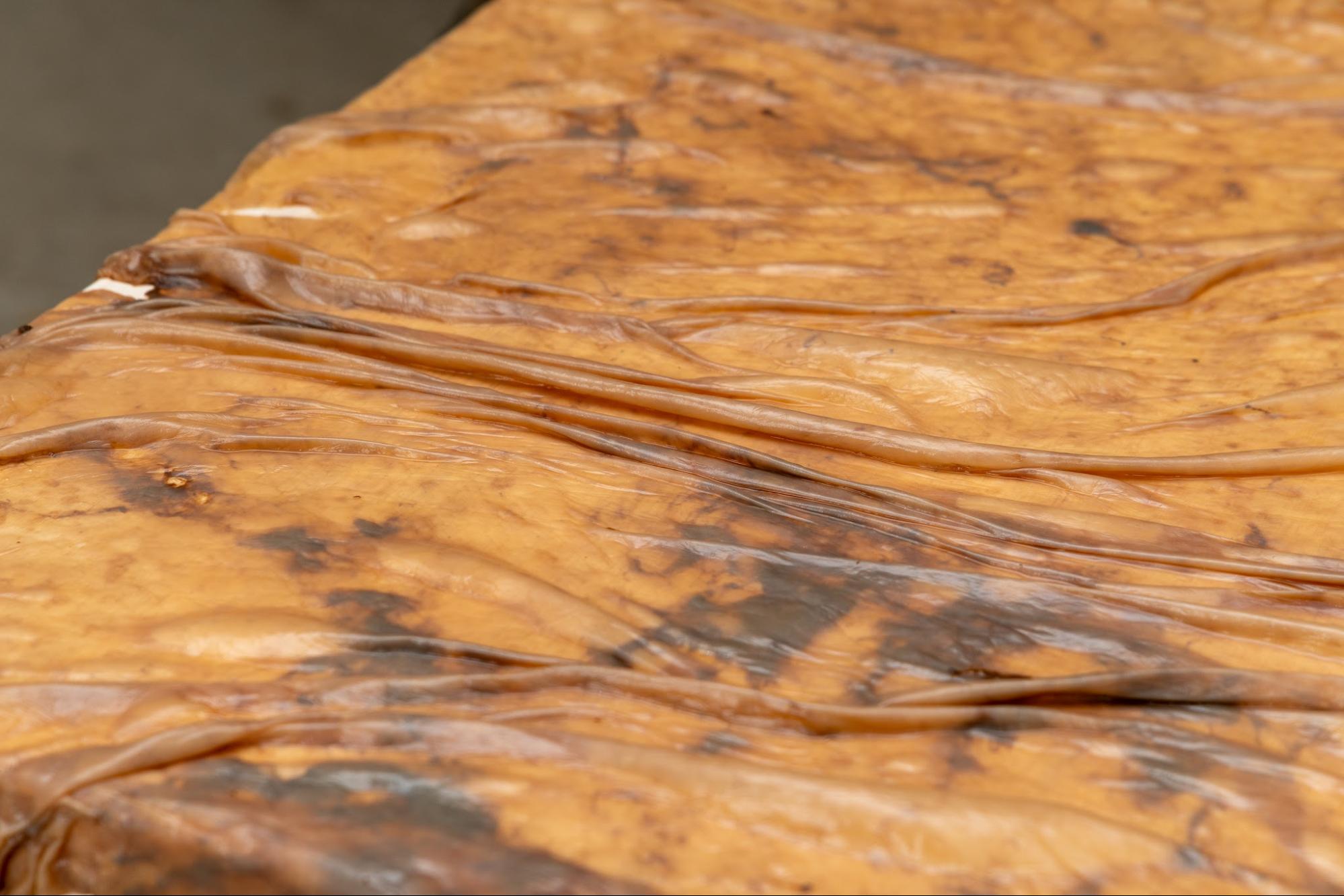
The most important material myth that emerged during the residency is the story of the table that landed from the sky. I imagined a large kombucha table resembling skin and the stomach of a bird. It lands on the island like a bird arriving from the sky. When people are hungry, the miraculous table comes down and offers them food. Everyone who is kind to the birds of the island is welcome at the table. Food eaten is something both birds and humans can eat, as if you're eating salty sea rocks from a bird's stomach, with a piece of snail and grass but tasting like the most delicious pancake.
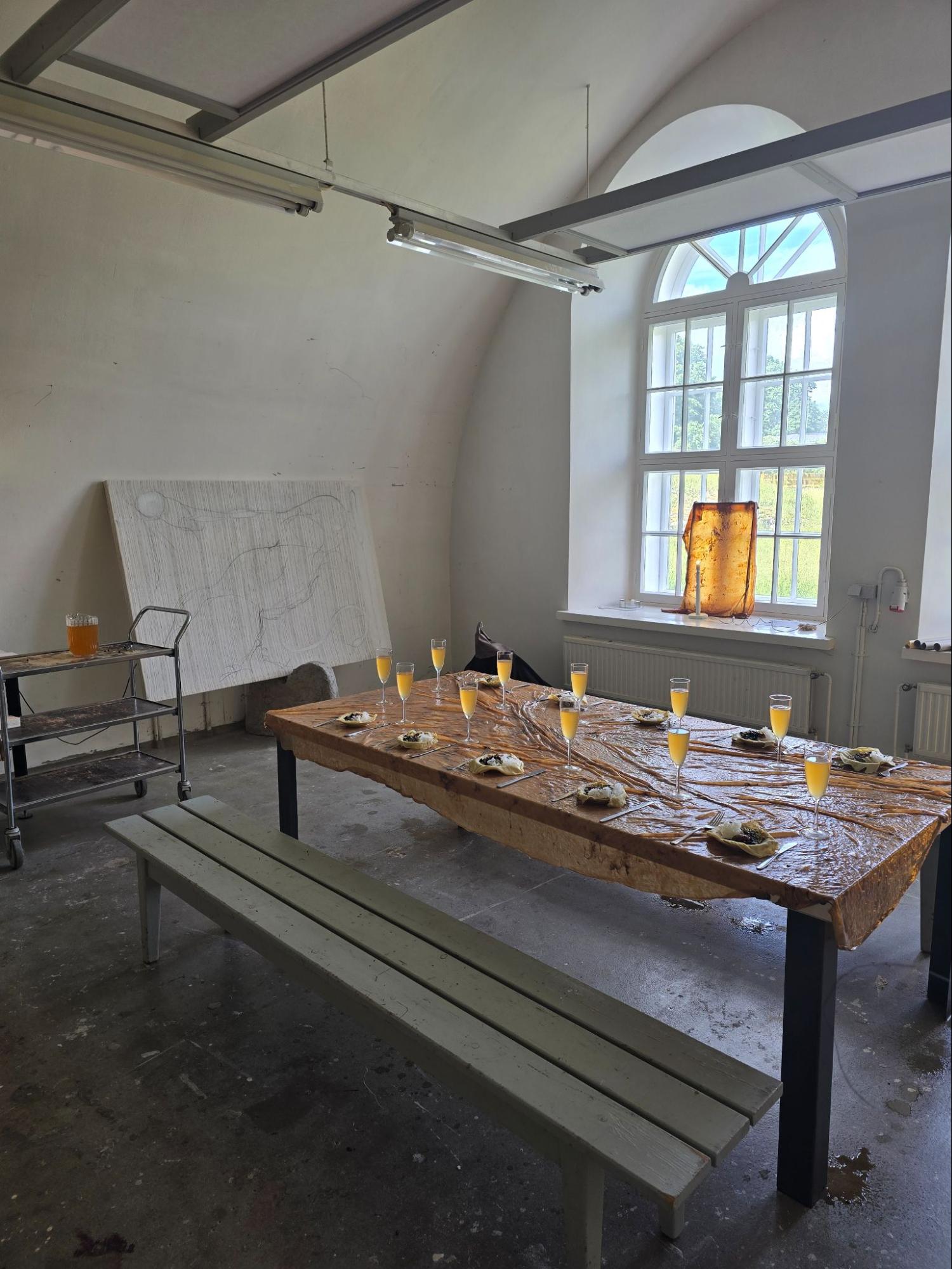
The table became a central connection between my material research, mythology, food, and community. It is simultaneously a skin, a stomach, a sculpture, a shelter, and a place of gathering. Around it, people can eat, drink, touch materials, smell them, listen to stories, and encounter the environment through my translations of it. I realised that the table allows my research to move out of the studio and become a shared experience.
This developed into my Learning Materials Lab: the table becomes a social and sensory research space. I am interested in allowing people to experience materials through touch, smell, taste, conversation, and storytelling rather than only looking at them. The gathering becomes another way of communicating with the environment and with one another – like sharing myths, finding connection with the environment and each other.
Foraging has become an important part of this process. I collect materials from the environment and treat them as clues or fragments through which the landscape can tell stories. I transform and preserve them, and then translate them into myths that can be shared with other people. In this sense, my role is not only to make objects but to listen to the surroundings, interpret what I find, and communicate these stories back through materials and community.
The paintings I developed during the residency emerged from the same process. I looked at the landscape of Suomenlinna and allowed natural forms to become characters, bodies, and stories. Seaweed became hair, surfaces suggested skin, geological forms took the shape of creatures and the landscape became a place where personal mythology can emerge.
My work, Skin as Shelter brings these experiments together as an ongoing investigation into transformation, camouflage, preservation, and coexistence. Skin is and can become shelter: a protective layer, a costume, a body, a home, or a way of belonging to an environment.
I am interested in what happens when materials are allowed to change identity. What if a person could become a flower? What if a bird's unusual body allowed it to leave its flock? What if a rock could glow and call sailors towards the sea? What if a sheep could live inside a tree? What if shit could become a castle? What if a table could fall from the sky and feed those who are kind to birds?
In my practice on Suomenlinna, through these transformations, I was building a mythology of the island in which humans, animals, plants, rocks, waste, food, and landscape are constantly shifting into one another. Myths are not separate from my material research; they grow directly out of it. Materials become a language through which I listen to the environment, translate what I encounter, and invite other people into the same conversation.
At the centre of my practice is the belief that transformation can create empathy. By making one thing resemble another, I try to imagine relationships across boundaries that normally separate us: human and animal, plant and body, beautiful and ugly, living and decaying, waste and value, shelter and skin.
During my residency period I found out that any environment can help me to create a new story, a new sculpture, to paint a new connection.
–––
Paula Zvane is a Latvian artist working across sculpture, installation, and painting. Her practice centers on natural and bio-based materials, including kombucha leather, recycled fur, linen fibre, oils, organic residues, and pigments to explore memory, empathy, and ecological interdependence. She studied at the Art Academy of Latvia (BA) and holds an MA in Fine Art from Central Saint Martins, London. Shown internationally, her work reimagines matter as hybrid, surreal, skin-like structures that engage contrasts of life and death, fragility or sturdiness. Through research-based experimentation, Zvane engages communities while investigating myths, cultural patterns, and material relationships between human and nonhuman worlds.
Zvane participated in the Learning Materials pilot residency in 2026 realised in collaboration between Bioart Society, HIAP – Helsinki International Artist Programme, Koynẽ Program, SWAMP: Art Material Swap and Waste Management Point and TUO TUO, and funded by Nordic Culture Point.